
Bitcoin Rides Out the Bond Rout
Every Monday, we deliver a concise yet comprehensive briefing to help you navigate the week ahead.
Our weekly market dashboard brings together key insights across Macro, Crypto, and Onchain activity, distilled into a clear, actionable format. Whether you’re managing risk or spotting opportunity, start the week informed and aligned.
Bitcoin Rides Out the Bond Rout
Headline
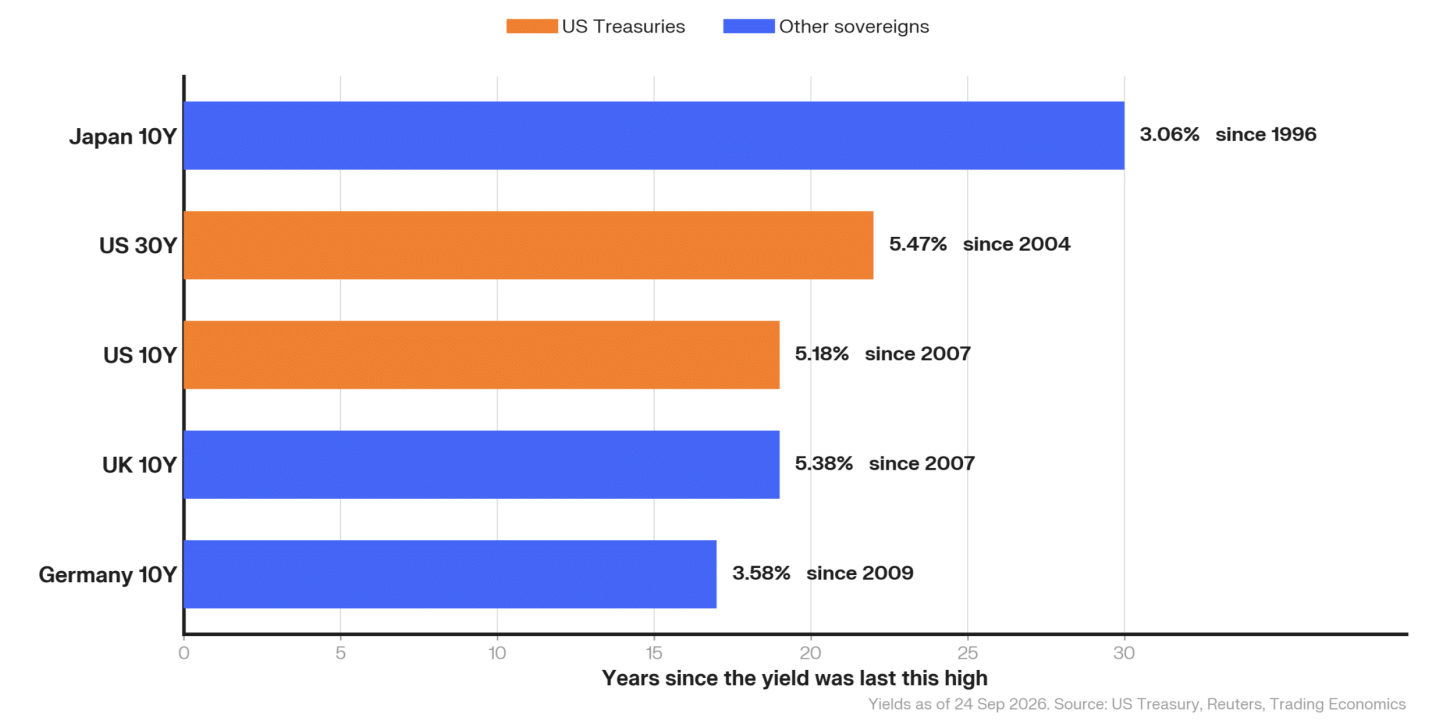
Long dated Treasury yields broke to two decade highs this week, and Bitcoin rallied straight through the news to a four month high before the rate shock finally pulled it back.
Proof
The thirty year yield rose to 5.47%, its highest since 2004, and the ten year climbed to 5.18%, its highest since 2007, both up more than a dozen basis points on the week.
The trigger was inflation as S&P Global’s September activity survey hit a five year high while input costs rose at their fastest in four years, a five year note auction drew the softest demand since 2018, oil pushed back toward $105 after a strike on Saudi Arabia, and several Fed officials said more hikes are coming, lifting October hike odds to about 71% from roughly 53% earlier in the week. Risk assets mostly looked past it. Bitcoin rose 4.3% to $84,458 and touched $87,158 on Wednesday, its highest in about four months.
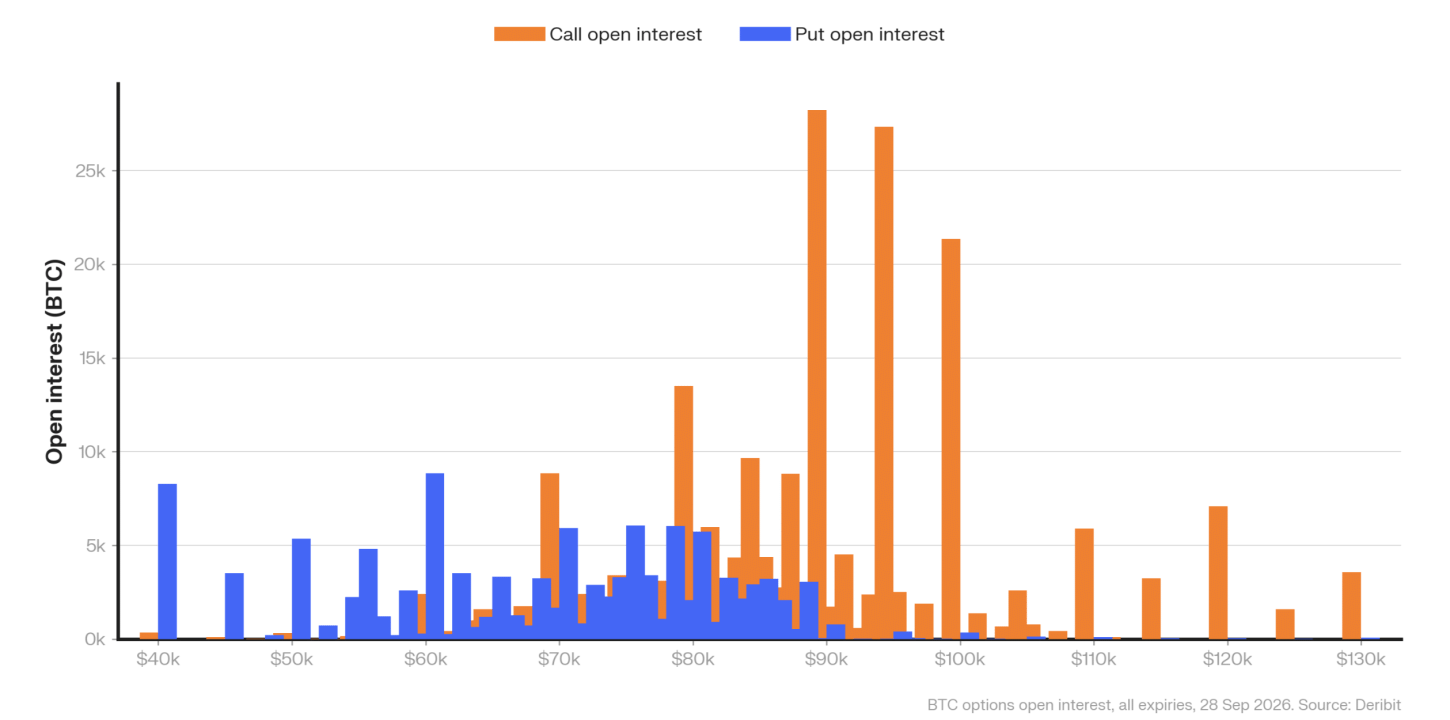
The Nasdaq 100 gained 3.3%, while gold slipped 1.9% and the dollar firmed 0.8% as the hawkish repricing did its work. In options the move never sparked much fear, with Bitcoin implied vol holding in the mid thirties and near dated skew leaning toward puts even as spot made new highs.
So What?
This is the bad news bulls trade again, and this week stress tested it. Bitcoin was handed the ugliest bond tape in years, a more hawkish Fed and $105 oil, and it still cut to a four month high before giving ground.
We have called this the early part of an uptrend for weeks and we still do, with Bitcoin 33% below its October 2025 peak and its higher low structure intact. But the week also drew the line.
Rates are now the variable that matters, and when the long end accelerated late in the week Bitcoin finally flinched, so the uptrend needs the bond selloff to cool rather than compound.
ETFs Take Over From Leverage
Headline
The bid that carried crypto this week came from spot ETFs rather than leverage, with Bitcoin funds pulling in $2.25b as open interest and funding came down, a healthier setup than last week’s leverage led push.
Proof
Spot Bitcoin ETFs took in $2.25b on the week, with Ether funds adding $602.8m and Solana funds $101.4m, a sharp turn from the prior week when Bitcoin funds were flat and Ether funds bled.
BTC open interest peaked at $61.7b on Monday as price ran to $87,158, then unwound to $56.75b by Friday as the yield shock pulled spot back, and funding cooled from 0.012% to 0.002%. ETH open interest slipped from $36.9b to $34.8b. Beneath the majors capital kept rotating out the risk curve, with AI and DePIN tokens both up about 22% while DeFi finished flat and exchange tokens gained under 3%.
The standout was Quant, which rose more than fivefold after The Clearing House, owned by 25 of the largest US banks, picked it to run its tokenized deposit network. That one token lifted real world assets 34% on the week, a sector that gained about 7% without it. Among the majors Solana and XRP both outpaced Bitcoin, up 9% and 7% against its 3.7%.
So What?
Last week we called the move renting leverage rather than buying spot, and we wanted the ETF bid to reconnect before trusting it.
This week it did. Fund creations replaced perpetual leverage as the marginal buyer, and the leverage that built into Monday’s high was flushed on the pullback without breaking the trend, which is the funding reset we flagged as the risk arriving in its healthiest form.
A spot funded bid is stickier and less reflexive than one running on funding, so we read this as the uptrend maturing rather than stalling. We would watch whether Bitcoin ETF creations hold up now that price has cooled, whether funding stays benign, since a snap back above 0.01% would say leverage is crowding back in, and whether the rotation into altcoins broadens or narrows.
Follow the Fees
Headline
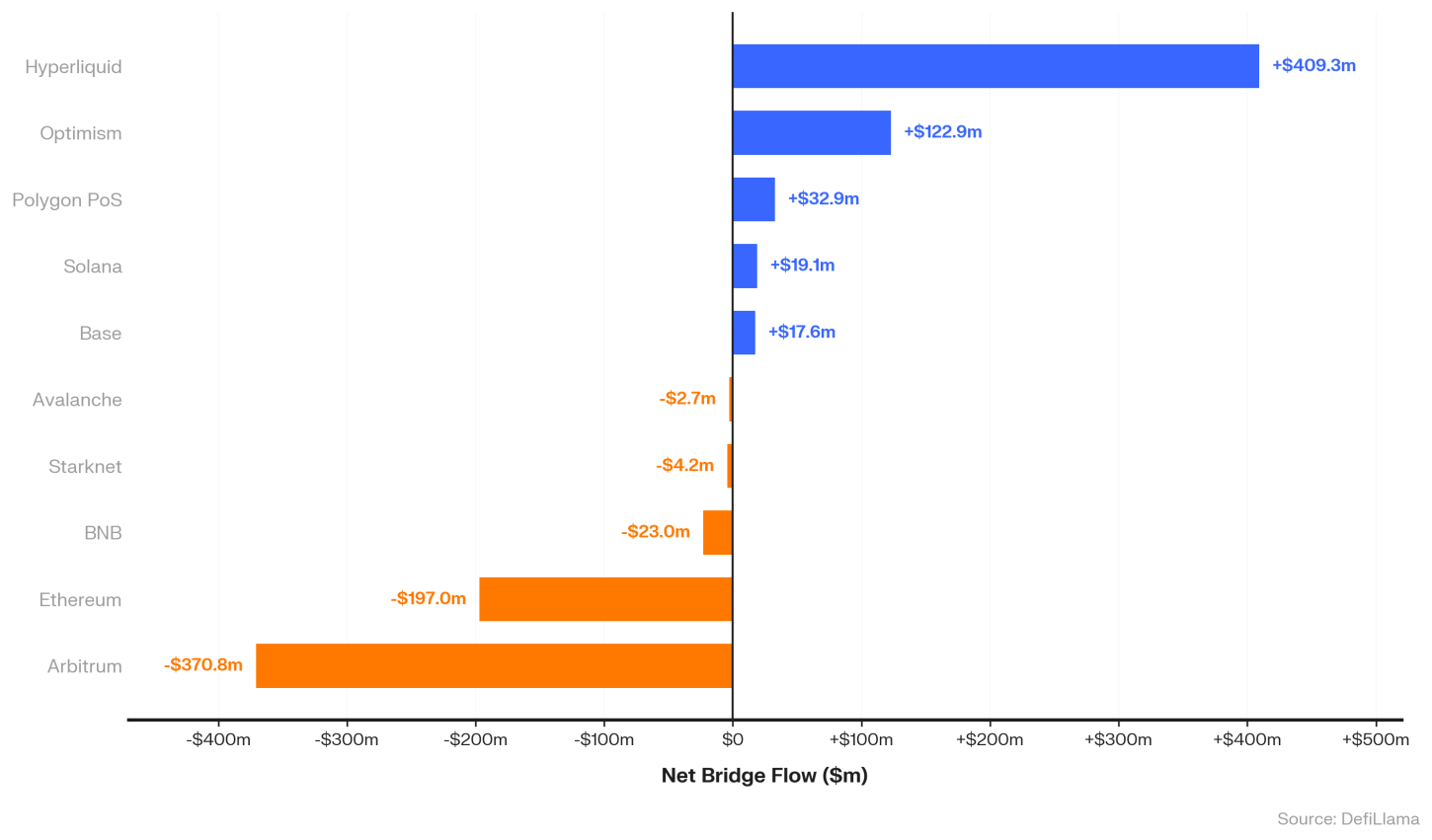
Hyperliquid absorbed a net +$409.3m in bridge inflows while Arbitrum shed -$370.8m and Ethereum -$197.0m, money physically leaving generalist venues for the perp-DEX L1 that now clears roughly 44% of onchain perpetual volume.
Proof
Three catalysts landed on Hyperliquid this week. Binance spot-listed HYPE on 24 Sep, the last major exchange to do so, HYPE printed an all-time high of $97.99 on 23 Sep, and the Assistance Fund passed 47.5m HYPE cumulatively bought back and burned by 26 Sep.
The same rotation ran through lending and credit. WETH deposits on Aave fell -4.48%, about $257m, as ETH-collateral loops got trimmed in a market wide leverage reset that took open interest down roughly -12.6%. The WETH supply rate rose to 1.47% purely because the pool got thinner. USDe wicked to $0.92 on Binance on 22 Sep and cascaded zero liquidations. In RWA, Centrifuge bled -17.86%, a second straight week near -18%, and -39% across 30 days, as its dominant allocator Sky/Grove pulled roughly $535m out of the Janus Henderson Treasury fund through new instant exit rails with NAVs stable.
Maple went the other way, up +6.79% to $4.8b AUM as syrupUSDC passed $1b. Aggregate RWA was flat at +0.16%. All of it played out under Bitget’s ~$387m hot-wallet drain on 24 Sep, the largest single hack of 2026.
So What?
The desk read is that capital is moving toward venues that pay and away from passive positions that don’t.
Perp fees, onchain credit and regulated dollar yield are pulling it in, while generalist L2 TVL, Aave WETH lending at 1.47% against roughly 2.66% native staking, and tokenised T-bills are on the losing side of the same trade. The Hyperliquid flywheel tightens from 3 Oct, when Circle USDC reserve yield starts routing into the Assistance Fund, an estimated $135m to $160m a year of extra buyback. Bridge flows are choppy and do reverse, the week of 7 Sep ran the other way, into Arbitrum, so the tell is persistence.
Watch whether Arbitrum and Ethereum keep bleeding into October, whether HYPE holds above $90 into the 3 Oct activation, and whether Sky’s Centrifuge redemptions stabilise or UTRSY draws down a third straight week.
Take Rate Flipped
Headline
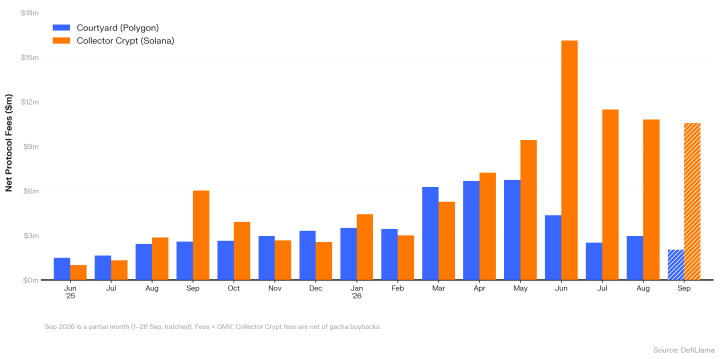
Graded trading cards are one of the busiest RWAs onchain, for which the past few months has seen the trading venue rotate. Collector Crypt on Solana earned $10.6m of net protocol fees in September to the 28th, against Courtyard’s $2.0m on Polygon, a roughly 5x gap that did not exist six months ago.
Proof
Through spring the two tracked each other, and Courtyard, the graded card vault typically cited in reference to the sub-sector, peaked at $6.7m of monthly fees in May 2026. Then Collector Crypt’s gacha model broke away, spiking to $16.1m in June on the mid-month Solflare Packs launch and holding a double digit run rate since, $10.8m in August and $10.6m through September, while Courtyard faded back to $2.0m.
Courtyard is a low take marketplace, roughly 2% of volume, with 0% seller fees and a 90% floor buyback. Collector Crypt is a randomised pack machine that keeps an 8-9% spread, which is why its fees run five times larger on comparable volume. Both series are net of buybacks, so this is take home revenue and not headline GMV.
For scale, Collector Crypt’s $3.24m of fees over the last seven days edged Uniswap’s $2.88m, off a book that carries almost no balance sheet, physical-TCG TVL is about $19.5k, because the cards sit in a Montana vault.
So What?
For an allocator the signal is product mix. Headline ‘onchain card volume’ blends a real secondary marketplace with a buyback-and-repack loop, and the number that survives a credit committee is net fees, where Collector Crypt now wins and Courtyard is shrinking.
The catalyst to watch is distribution. Collector Crypt’s inventory went onto Robinhood Chain on 26 Sep via “The Alley”, roughly 50k cards worth $54m, the same channel expansion move that drove the June spike, so the October fee print is the test of whether the run rate steps up again. GMA’s 24 Sep note argues much of Collector Crypt’s headline $1b volume is open-buyback-repack churn, and Collector Crypt’s own 25 Sep clarification that “Powered by” mirror cards on other chains are not redeemable at the vault is the risk to underwrite before anyone files this under institutional RWA.
Watch the October fees and whether Courtyard’s marketplace take stabilises or keeps sliding.