
Historical reference: 31 August 2026. Research text and original charts reproduced from supplied reference images with source attributions. Not live market data or investment advice.
Bitcoin Anchored
Every Monday, we deliver a concise yet comprehensive briefing to help you navigate the week ahead.
Our weekly market dashboard brings together key insights across Macro, Crypto, and Onchain activity, distilled into a clear, actionable format. Whether you’re managing risk or spotting opportunity, start the week informed and aligned.
Join our Telegram Channel to get it delivered directly to your phone.
Headline
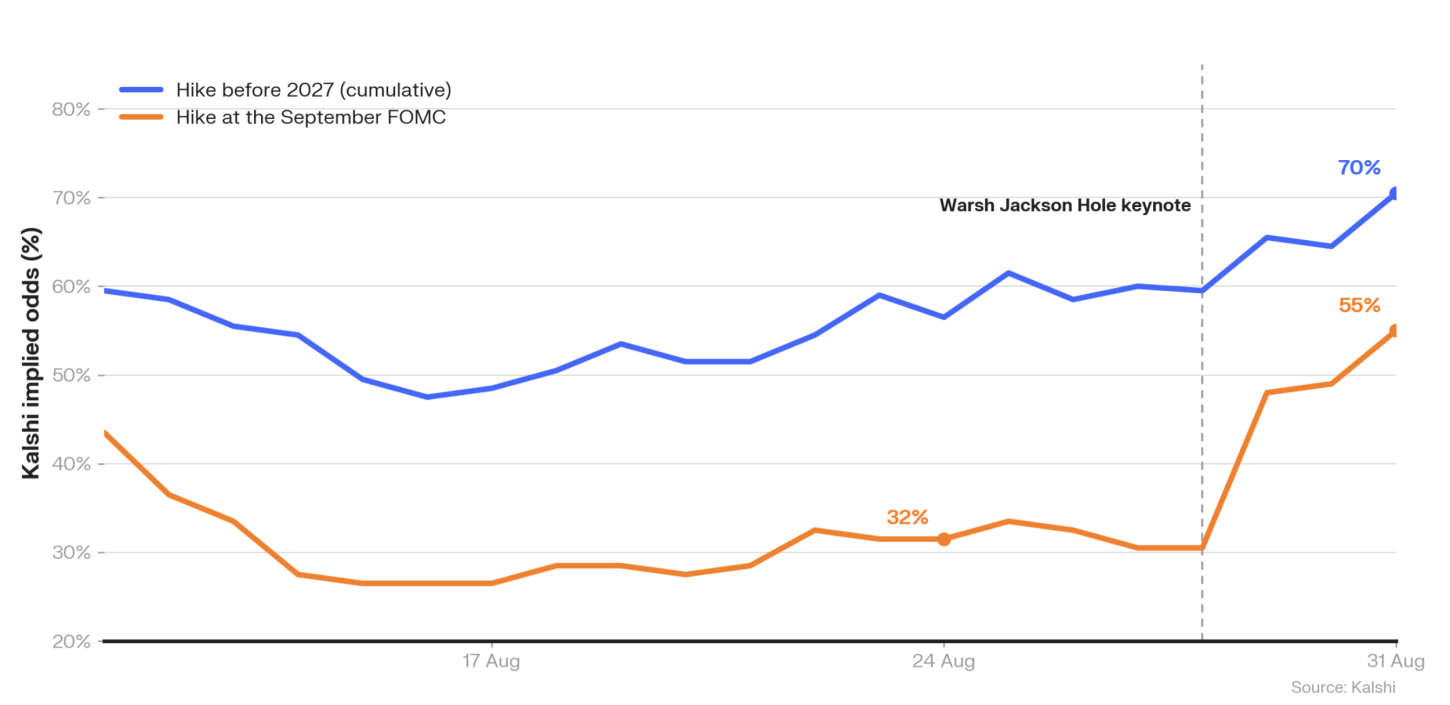
Warsh’s hawkish debut cooled last week’s debasement trade and pushed the pressure on yields to the short end, the one part of the curve the Fed controls and the Treasury’s buyback are not reaching, while Bitcoin held the gain that gold gave back.
Proof
Warsh used his first Jackson Hole keynote on Aug 28 to call inflation still too high and to name short rates his main tool, and the market heard it, with September hike odds jumping to about 57% on CME from near 40% as rate cuts fell out of the curve entirely.
The repricing hit the short end, where the two-year yield rose 10bp to 4.34%, while the Treasury’s new buyback kept the long end pinned and the thirty-year slipped 5bp to 5.22%. The same hawkish turn cooled last week’s debasement trade, sending gold down 5.0% to $4,422 and the dollar up 0.8%, and it erased Nvidia’s record Nasdaq close from Aug 27 to leave the index flat on the week.
Bitcoin was the one hard asset that held, up 0.5% and clinging near $77,700 despite its implied volatility falling almost 12%.
So What?
The near-term tape belongs to Warsh, but the months ahead still look constructive for Bitcoin.
The debasement thesis that drove last week’s run has not gone away, since the government is still capping its own long bond while the Fed fights inflation at the short end, and that tension is exactly the backdrop hard assets reward.
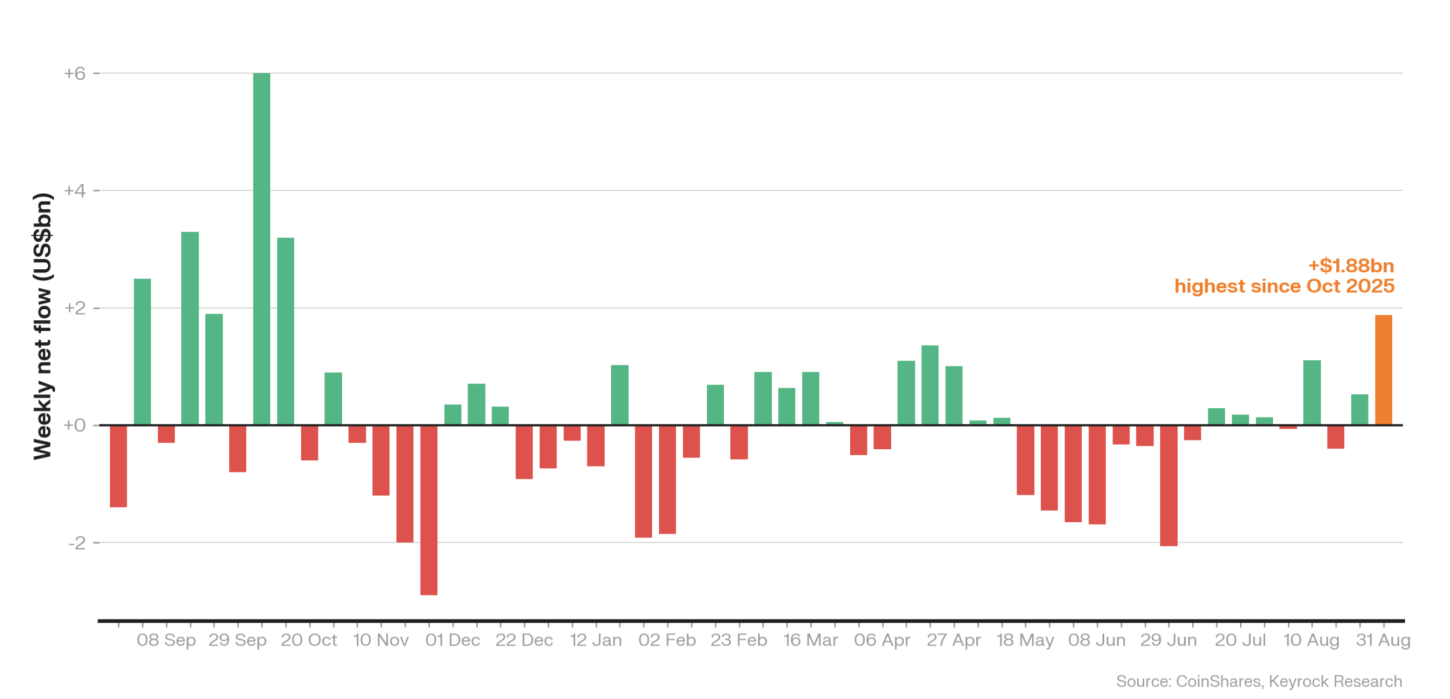
The flows back it up, with spot Bitcoin ETFs adding more than $3bn across a nine-day streak and August net inflows near $3.3bn even after Friday’s outflow.
We read the low-volatility hold as base-building into a firmer fourth quarter rather than a market that has topped. We are watching the September jobs and CPI prints and the Sept 15-16 FOMC to see whether a hike briefly interrupts the thesis or the debasement bid simply reasserts.
Retail Runs Hot
Headline
The retail speculation layer roared back to multi-month and record highs over the weekend, with Solana meme volume, pump.fun revenue and Robinhood’s own chain all surging even as macro cooled the majors and altcoin breadth narrowed back toward Bitcoin.
Proof
Meme majors actually fell hard with the sector down about 11% and PEPE off 17% on the week.
Solana cleared $5.2bn of meme spot volume in the week to Aug 26, its most since November and roughly 85% of all meme trading. pump.fun ran its best week since February at $13.7m of revenue, including a $2.4m single day, while its mobile app crossed $50m of daily volume and more than 900,000 daily transactions.
Robinhood’s own layer-2 chain was the standout, printing a record near $945m of daily DEX volume on Aug 29 with active wallets back above 115,000, as memecoins and tokenized stocks collided on Uniswap.
So What?
We read this as a genuine pulse of retail risk appetite. We would watch whether Solana volume and Robinhood Chain usage hold once this weekend’s names cool and whether any of it broadens beyond a handful of tickers into something that lifts breadth.
Leverage Drains
Headline
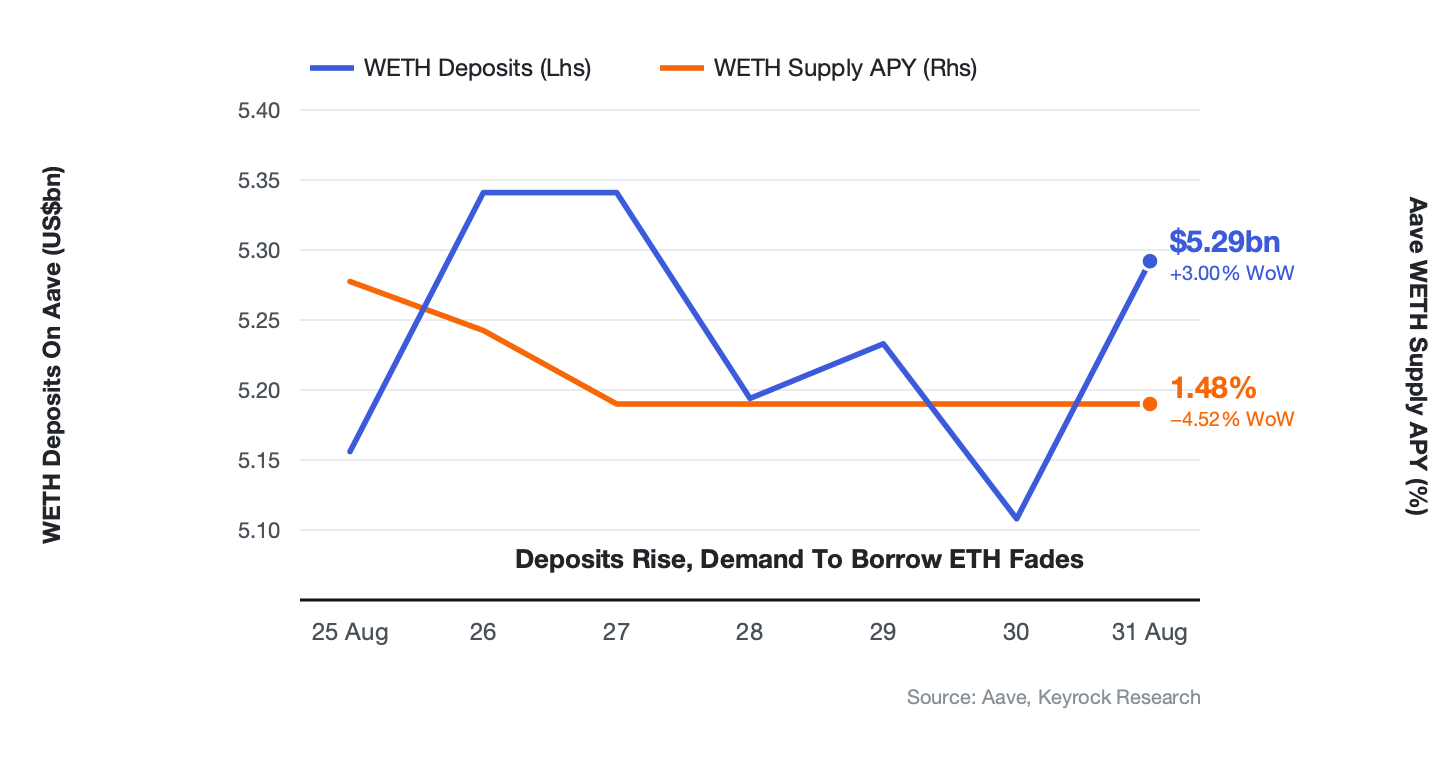
WETH deposits rose +3.00% to $5.29B while the supply APY fell -4.52%. ETH is being supplied faster than the market wants to borrow it, and the appetite to lever or short ETH onchain is fading.
Proof
The WETH supply rate is set by utilisation, how much of the pool is actually being borrowed, so it falls when deposits grow faster than borrow demand.
That is this week, where deposits increased roughly +$154M, and the rate dropped to 1.48%. The borrowers of WETH are mostly leveraged staking loops and shorts, so a lower rate reads as less of both. Stablecoins showed no leverage impulse either way, USDC deposits rose +3.36% with the rate pinned at 3.27%, USDT deposits were flat at -0.03% with the rate down -1.47%.
The backdrop fits. ETH held a tight $2,450-$2,546 band all week after its mid-month squeeze, the staking ratio crossed ~35% of supply with native APR compressed to ~2.7%, and staking-enabled ETF wrappers drew inflows, BlackRock’s ETHB taking +$42.6M on 28 Aug inside a nine session ETH ETF streak that peaked at $225.8M on 27 Aug.
Chain flows told the same story, where Arbitrum’s +$175.3M inflow and Hyperliquid’s -$187.3M outflow are one flow. Hyperliquid’s USDC bridge is an Arbitrum contract, so withdrawals land back on Arbitrum.
Traders pulled size after HYPE hit an $86.71 ATH on 27 Aug, ahead of the ~$1.2B token unlock on 29 Aug. RWA sat it out, aggregate AUM flat at -0.04%, Securitize +3.29% on subscriptions into Neuberger’s new tokenised high yield fund, Paxos -5.02% as its PAXG-heavy book marked down with gold.
So What?
The marginal appetite to lever ETH onchain has drained, and that is the tell to track. Watch WETH utilisation and the supply APY together.
A move back above ~2% on rising utilisation is the earliest sign that looping and short demand are returning, and it would front-run price.
Two other markers into next week are whether the ~$1.2B HYPE unlocked on 29 Aug drags Arbitrum’s parked USDC back across the bridge, and whether Warsh’s hawkish Jackson Hole keeps stablecoin borrow demand pinned.
Reinsurance Goes Onchain
Headline
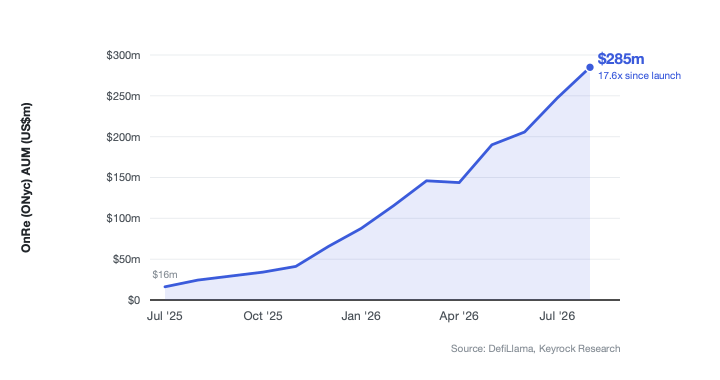
Tokenised reinsurance is becoming an onchain asset class. OnRe’s ONyc token grew AUM ~17.6x since its July 2025 launch to $284.9M, paying ~11.6% from real insurance premiums, a yield that is uncorrelated to both macro and crypto.
Proof
The curve barely moved for five months, then inflected in December 2025 at ~$66M and roughly quadrupled across 2026 to $284.9M by 31 August, per DefiLlama. NAV sits at $1.14 and net APY at ~11.6% against a ~16% base target, sourced from reinsurance premiums and collateral income rather than crypto carry or funding.
The category has a second name now, Re Protocol scaled to $328M TVL through August, edging ahead of OnRe by protocol size, though ONyc remains the largest single reinsurance token since Re splits across its reUSD and reUSDe tranches.
Together the pair is ~$613M, barely 2% of DefiLlama’s ~$27b onchain RWA market. About 60% of circulating ONyc is posted as collateral on Kamino, where reinsurance now sits among the largest RWA markets on Solana.
Set against the Onchain section, the contrast is the point, onchain dollar yields sit at 3-5% and Bitcoin lending at 1.48%, while reinsurance premium yield held ~11-12% through a week when the rate path itself was in doubt.
So What?
The appeal is the lack of correlation. Reinsurance premium yield is priced off catastrophe risk and treaty renewals, not the front end of the curve or perp funding, which is exactly what a portfolio wants when the macro signal is as muddy as Warsh left it.
That same independence is the risk, this is real insurance risk wrapped as a token, and a major catastrophe loss is the tail that tests whether ~11% is fair pay.
Watch three things, first whether OnRe’s August review, due around 1 September, for updated capital-on-risk and bound-deal count, second whether Re’s protocol-level lead widens; and third whether the tokenised reinsurance category clears $1b before EOY.
Join our Telegram Channel to get it delivered directly to your phone.